Abstract
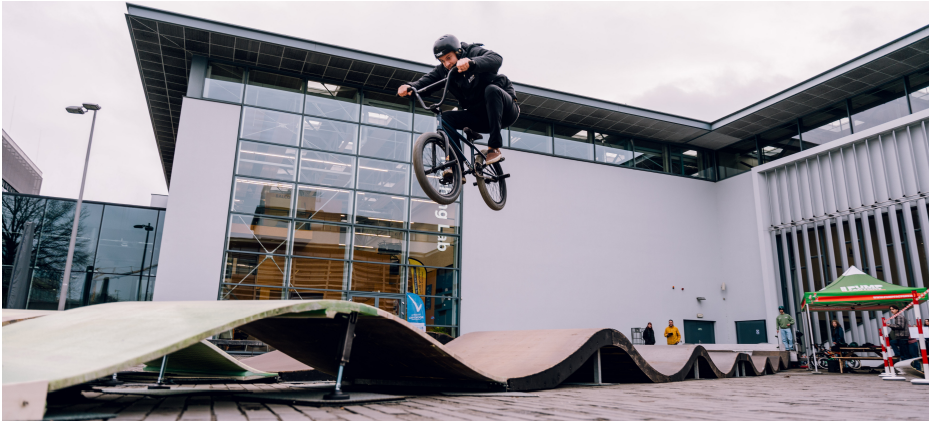
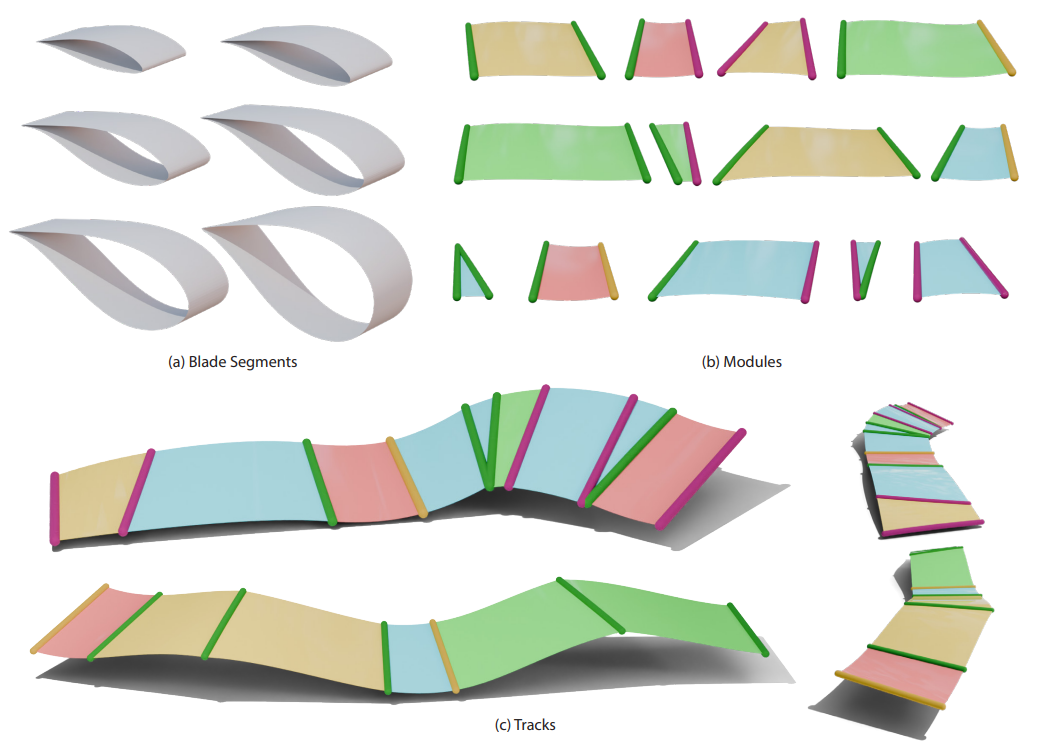
We explore the fabrication of curved surfaces by reusing panels extracted from decommissioned wind turbine blades, using cycling pumptracks as a case study. We first present real-world prototypes of pumptrack modules that we manufactured to evaluate the practicality of this reuse scenario and to define the boundary conditions for harvesting blade panels and assembling a track. We then propose an algorithm to optimize the segmentation of a wind turbine blade into quadrilateral panels whose sides fall within a small set of compatible boundaries. These panels form a library of modules that designers can connect side by side to create pumptracks of various lengths and curvatures. Together, these contributions provide a proof-of-concept of how computer-aided design and manufacturing can support circular design through the reuse of curved surfaces.
Results
Video
Citation
@InProceedings{PRPBJ25, author = "Pupping, Jesse and Riso, Marzia and Popescu, Mariana and Bousseau, Adrien and Joustra, Jelle", title = "From blades to tracks: a case study in structural reuse of curved surfaces for circular design", booktitle = "ACM Symposium on Computational Fabrication (SCF)", year = "2025", publisher = "ACM", url = "http://www-sop.inria.fr/reves/Basilic/2025/PRPBJ25" }