Abstract
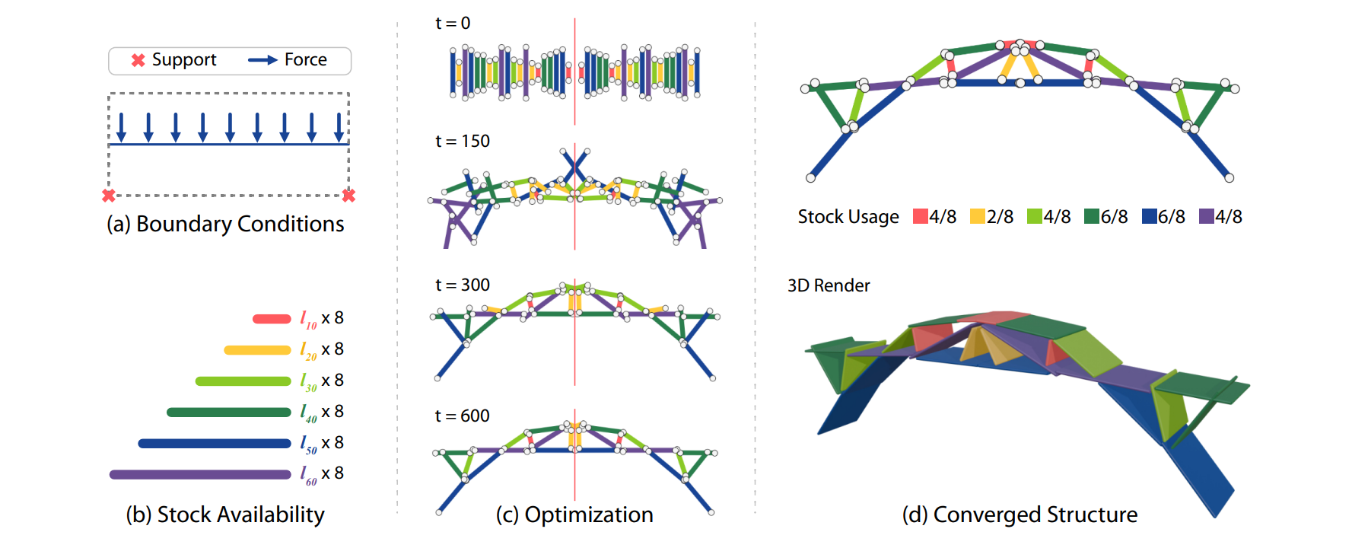
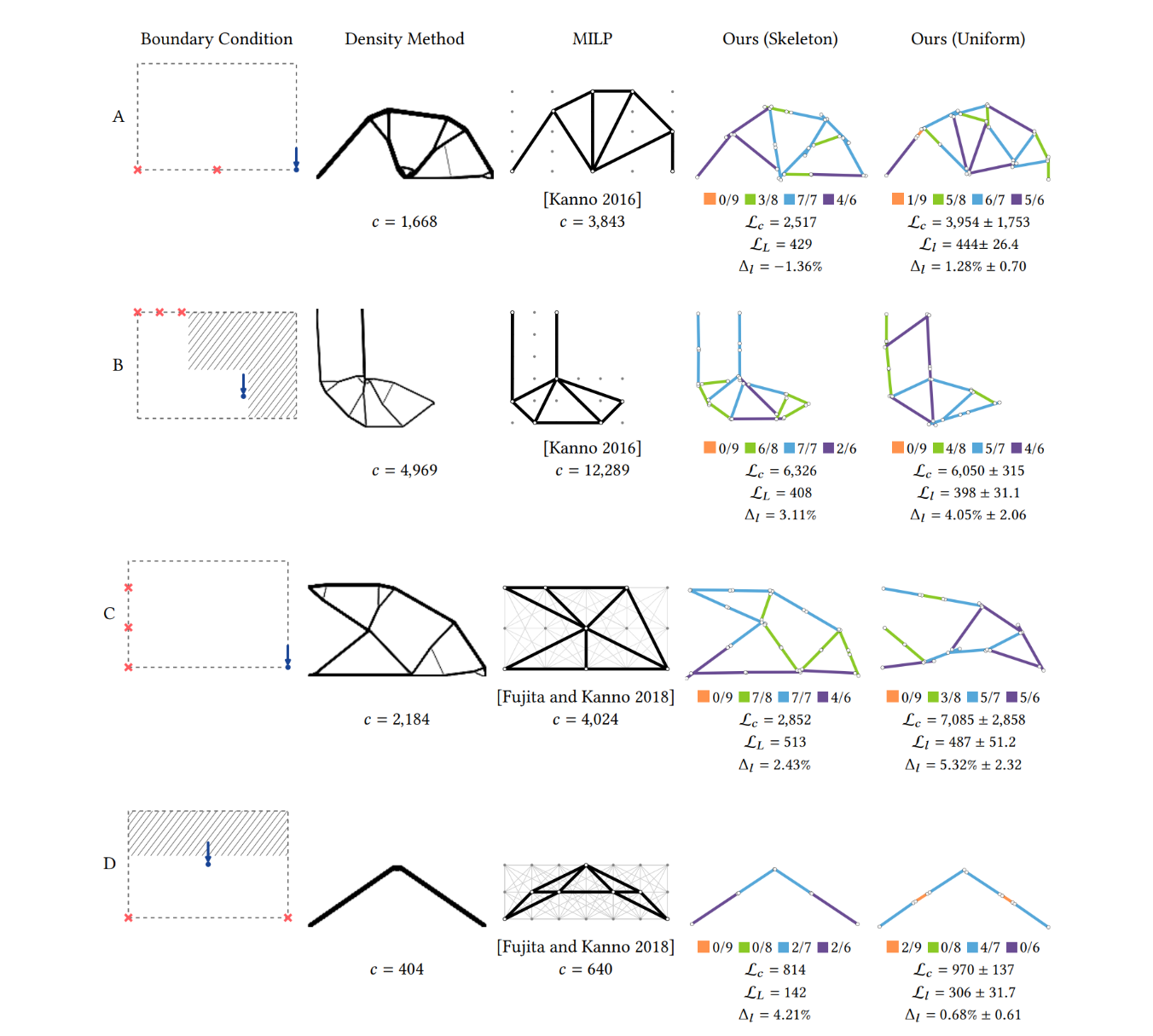
The growing awareness of resource limitations has driven increasing interest in reusing existing materials for structural design. Existing methods formulate reuse as an assignment problem, incorporating the discrete constraints on the dimension and availability ofreclaimed materials into complex combinatorial problems, which are often computationally expensive and restricted to predefined structural layouts. We present a continuous gradient-based formulation for the design of frame structures from a stock of decommissioned beams. Building on differentiable density-based solvers, our method enables end-to-end optimization of beams rotation, translation and length, without requiring a specific layout. By expressing the discrete beam types and stock availability as differentiable objective terms, our system converges to solutions that respect the stock constraints while discovering alternative layouts with structural properties comparable to those produced by previous approaches. We also demonstrate the flexibility of our continuous formulation by incorporating additional objective terms, such as image-based guidance for structural design, and by extending it to support other structural elements, like curved arcs.
Results
Video
Citation
@inproceedings{CRBSB2026, title = {{Differentiable Stock Constraints for Continuous Optimization of Frame Structures by Reuse}}, author = {Chen, Zhouyuan and Riso, Marzia and Baas, Berend and Schulz, Adriana and Bousseau, Adrien}, booktitle = {{Proceedings of the ACM Symposium on Computational Fabrication}}, organization = {{ACM}}, year = {2026}, doi = {10.1145/3828611.3845645} }