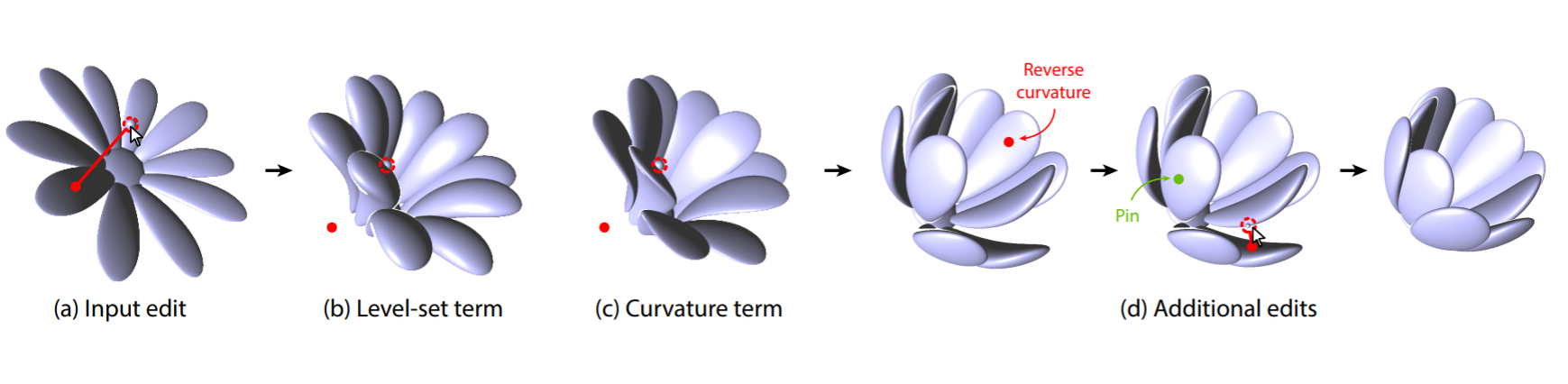
Parametric shape models often expose multiple, intertwined parameters. For example, this flower has parameters to control the
distribution of petals around its center, the opening of the petals, their bending inward or outward, their thickness. Instead of manipulating
these parameters individually, users of our approach can express desired shape changes by dragging points of the implicit parametric surface.
(a-b) Optimizing the model parameters to bring the implicit surface to the target point effectively closes the flower, but it also inflates the
petals. (c) We offer additional control by leveraging the differentiability of implicit surfaces. In this example, constraining the edit to preserve
curvature at the dragged point avoids inflation of the petals. (d) Other constraints allow the user
We present a method to perform drag-based editing of parametric shape models that represent classes of shapes as implicit
surfaces. These models typically expose multiple parameters to control variations of a shape, but achieving a desired edit often
requires tedious trial and error to find appropriate parameter values. Our approach lets users select points on an instance of
a parametric model and drag these points to specify desired transformations of the implicit surface. Our method then solves
for the model parameters that best satisfy these user-provided constraints. The key challenge we face is that implicit shape
models do not offer a consistent parameterization of their surfaces, preventing a direct association between points across shape
variations. Our solution to support diverse edits is to constrain the optimization to preserve local differential quantities of the
surface around the dragged points, offering users a means to control the orientation and curvature of the surface they drag
despite the lack of explicit point correspondences. Importantly, our approach applies to any differentiable parametric implicit
surface, including procedural models as well as neural implicits.
Results
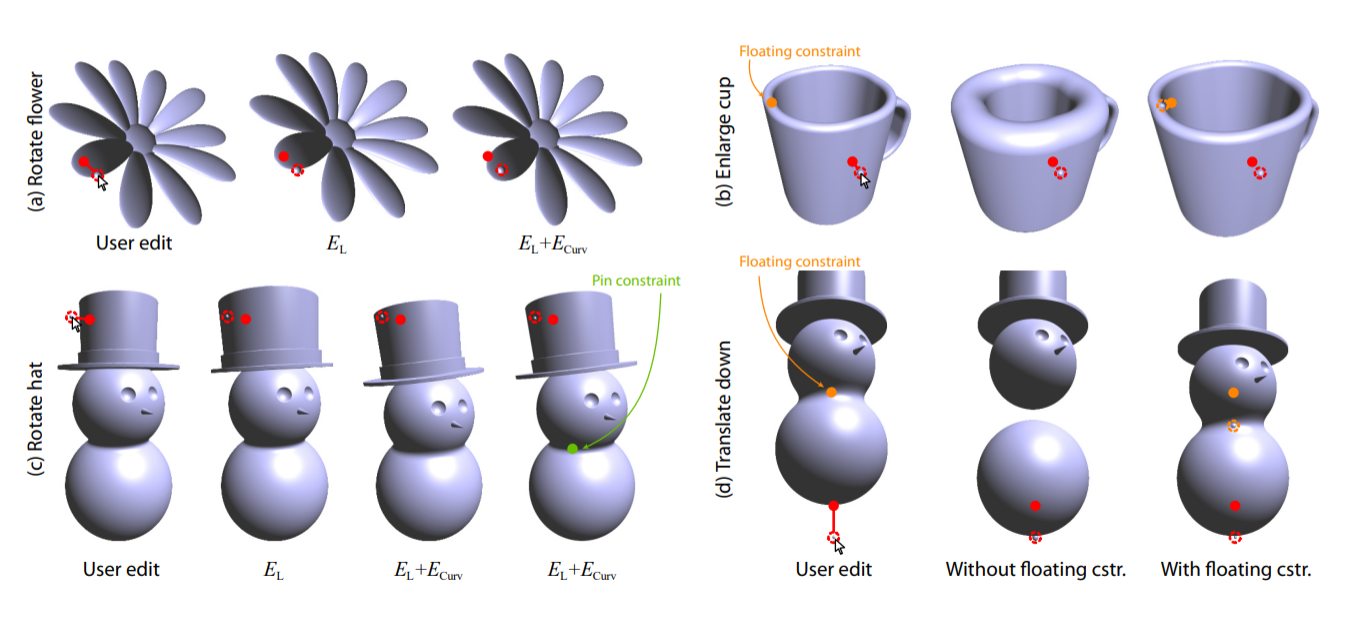
Results of our method on procedural parametric shape models. (a) Attempting to move the flower petal tangentially to its surface
does not produce any change when using only the level-set term. Adding the curvature term makes the flower rotate to follow the drag. (b)
The cup can vary in width and thickness. Setting a floating curvature constraint on its edge allows to maintain its thickness. (c) Similarly,
the hat of the snowman can vary in radius and in tilt angle. Dragging a point of the hat outward using the level-set term increases its radius.
Using the curvature term tilts the hat to keep the radius unchanged, but also lowers the head of the snowman. Adding a pin constraint on
the neck keeps the head at the same height. (d) The creator of the snowman model did not constrain the body to stay attached to the head.
Adding a floating curvature constraint on the neck allows the user to keep the head attached when translating the body down.
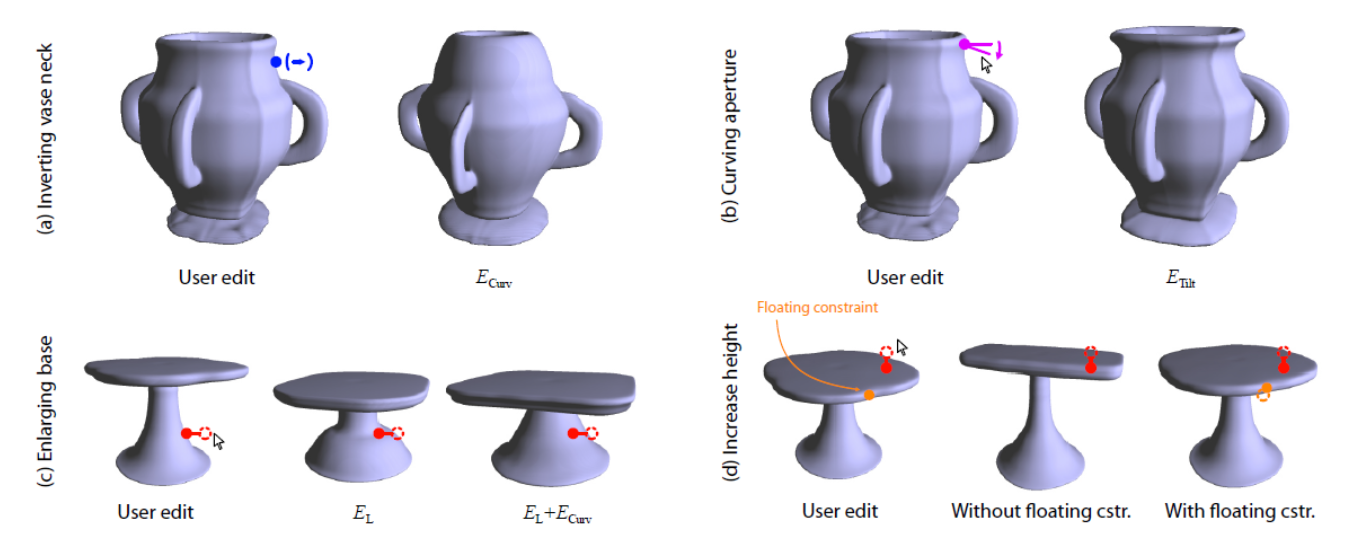
Results of our method on neural shape models. (a) In addition to disambiguating drag-based edits, our curvature term can also
be used to achieve a target curvature, here to change the top part of the vase from convex to concave. (b) The orientation constraint offers
local control to tilt the surface near the edge of the vase. (c) Dragging a point on the foot of the table using the level-set term increases the
foot radius but introduces a discontinuity in its profile. Adding the curvature term allows to enlarge the foot while preserving its profile. (d)
Attempting to raise the table by dragging a point on its top triggers a change of its shape, making the top thicker and rectangular. Adding a
floating curvature constraint along the top edge better preserves its shape.
Citation
@InProceedings{KRMCRB26,
author = "Kriel, Henro and Riso, Marzia and Muharram, Aamen and Chaudhuri, Siddhartha and Ritchie, Daniel and Bousseau, Adrien",
title = "ImplicitDrag: Drag-Based Editing of Differentiable Implicits",
booktitle = "Pacific Graphics Conference Papers",
year = "2026",
}